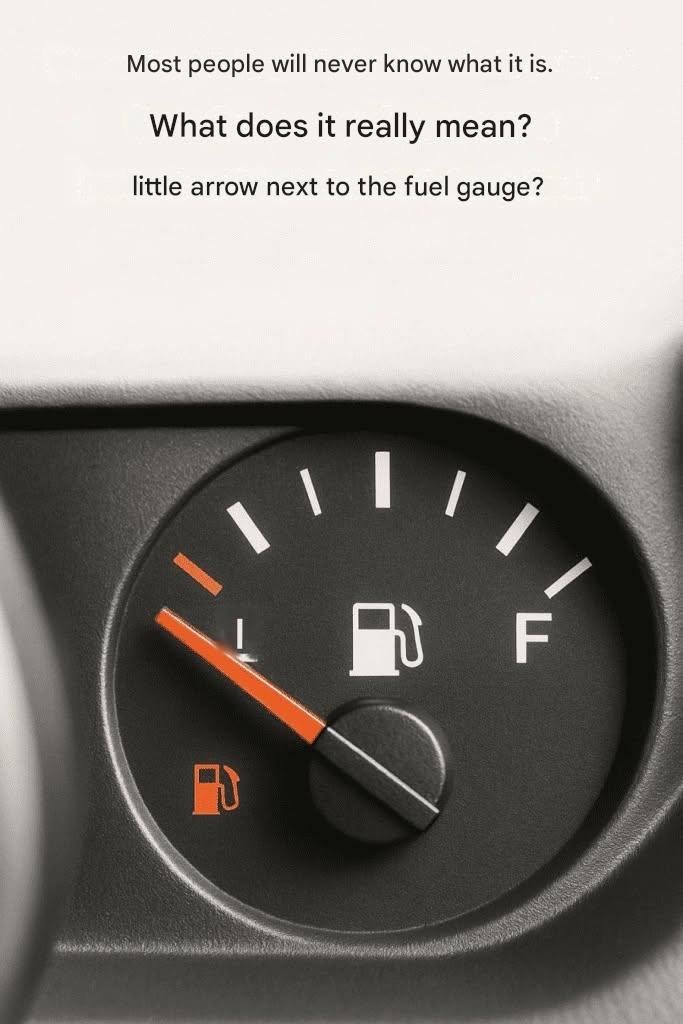
In the fast-paced world of motoring, where we’re often more focused on getting to our destination than on the journey itself, small details easily slip through the cracks. One such detail that many drivers overlook is the small arrow next to the fuel gauge on the dashboard. This seemingly insignificant feature remains a mystery to countless people, even though it can prevent embarrassing and stressful situations at the gas station.
For most people, filling up is a routine that doesn’t require much thought. However, for those who frequently change cars or drive a rental car, the location of the fuel cap becomes crucial. This is where the small arrow comes into play: it offers a simple yet effective solution to avoiding the difficult task of moving a car at the pump. Surprisingly, its function remains unknown to many drivers.
1. The Little Arrow Most Drivers Never Notice:
The little arrow next to the fuel gauge is overlooked by most drivers. Typically a barely visible triangle pointing left or right, it often goes unnoticed unless you’re looking for it. Strategically placed next to the fuel pump symbol on the dashboard, this arrow indicates which side the fuel cap is on. Despite its simplicity, the arrow serves a practical purpose, especially when driving unfamiliar vehicles.
For example, when driving a rented or borrowed car, finding the correct side of the fuel cap can be difficult. The arrow eliminates this guesswork and saves drivers the hassle of driving to the wrong side of the pump. In a world where convenience is paramount, this small detail improves the driving experience by making refueling much easier.
2. What the Fuel Gauge Arrow Really Means:
The arrow next to the fuel gauge has a simple but important function: it indicates which side of the vehicle the fuel cap is on. If the arrow points left, the fuel cap is on the left; If it points to the right, it’s on the right side. This simple indicator can save you a lot of trouble, especially when driving an unfamiliar car.
While it may seem obvious to those in the know, many drivers are unaware of this feature. The arrow is a subtle design choice that provides immediate information without the need for conscious thought or recall—a prime example of intuitive design in automotive engineering.
3. Why did car manufacturers ever add an arrow to the fuel cap?
The introduction of the arrow in the fuel cap stemmed from the need to improve driver convenience and ease of use. With the increasing globalization of the automotive industry, manufacturers recognized the importance of standardizing certain features to accommodate drivers who frequently switch models and brands.
Before the arrow’s introduction, drivers often had to rely on memory or get out of the car to check which side the fuel filler flap was on, causing unnecessary inconvenience. With this simple symbol, car manufacturers offered a simple solution to a common problem, improving the overall driving experience and reducing potential stress at the gas station.
4. How to easily identify which side the fuel tank is on.
The arrow next to the fuel gauge clearly and effectively indicates the fuel filler flap position. A quick glance at the dashboard when getting in the car helps avoid awkward maneuvers at the pump. This feature is especially useful in rental cars or when driving a friend’s car, whose functions may be unfamiliar.
The arrow’s function as a directional indicator demonstrates well-thought-out design, allowing drivers to intuitively understand its purpose without the need for detailed explanation. This small detail can save time and frustration, making it an invaluable feature for every driver.
5. When the arrow trick doesn’t work (and common exceptions) While
the arrow next to the fuel gauge is a reliable indicator in most vehicles, there are exceptions. Some older models or specific car brands may not have this feature, forcing drivers to rely on traditional methods of determining the gas cap’s location. Furthermore, this feature may be absent in custom dashboards or modifications. It’s also important to remember that while the arrow is useful, it shouldn’t replace consulting the owner’s manual or physically inspecting the gas cap when in doubt. 6. How this unassuming dashboard icon became a viral lifehack: The arrow on the gas cap has gained widespread recognition as a “lifehack” thanks to social media and online forums. Drivers who discovered this feature shared their discoveries online, surprising and fascinating those who weren’t aware. As more and more people learned the purpose of the arrow, it quickly became a popular topic of conversation. Many expressed disbelief that they hadn’t noticed it sooner. This rapid spread of information highlights the power of social media in educating and informing the public about seemingly trivial but useful facts. 7. Car rentals, road trips, and the arrow that saves you from embarrassing traffic jams. When traveling by road or renting a car, the arrow on the fuel cap proves invaluable. Many drivers know the unpleasant feeling of pulling up to a gas pump and discovering the fuel cap is on the wrong side. This can lead to time-consuming re-parking or even waiting for an empty pump. By checking the arrow shortly before filling up, drivers can avoid these inconveniences and make the filling process smoother and more efficient. This small detail improves travel comfort and allows drivers to focus on the journey rather than on logistics.